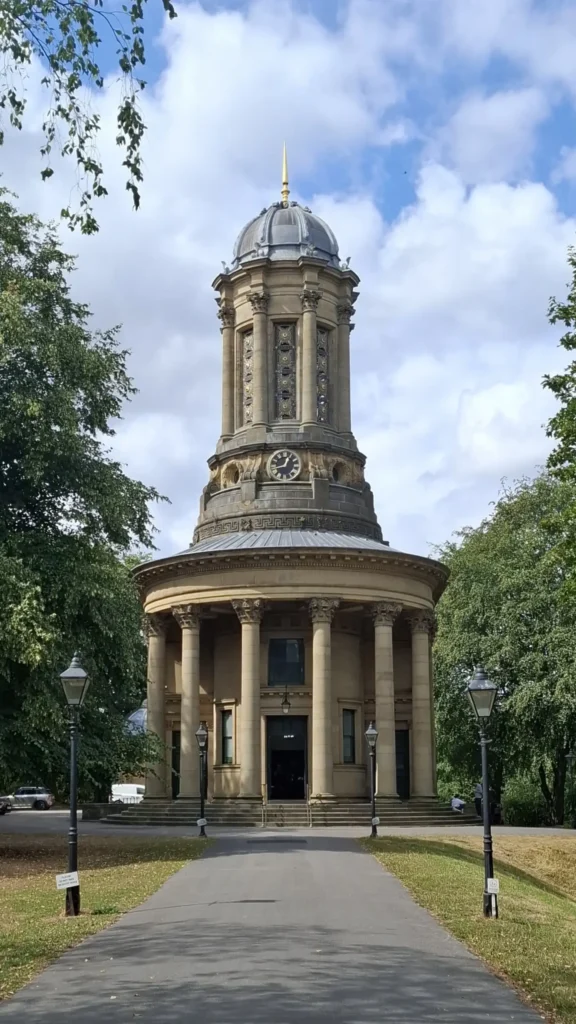


SALTAIRE UNITED REFORMED CHURCH
Welcome to this independent website created by the Friends of Saltaire United Reformed Church.
This site is not the official website of the church and does not represent its leadership, congregation, or current activities. Its purpose is to preserve and share the history, architecture, and community significance of this remarkable building.
Saltaire United Reformed Church stands in the heart of the model village of Saltaire, West Yorkshire, and has long attracted visitors drawn by its architecture, heritage, and place within the village. Historically, the church has hosted regular worship, ceremonies such as weddings and baptisms, and community gatherings throughout the week.
A CATHEDRAL OF CONGREGATIONALISM

Saltaire United Reformed Church is widely regarded as one of the nation’s most important Victorian architectural landmarks. Built in 1859 by Sir Titus Salt near Bradford, it is a striking example of Italianate religious design and has often been described as a “Cathedral of Congregationalism.”
This Grade I listed building—placing it in the same category as landmarks such as Hampton Court Palace and Salisbury Cathedral—sits in the valley of the River Aire, at the edge of the Pennine Moors and gateway to the Yorkshire Dales.
The church was funded entirely by Sir Titus Salt as part of his vision for Saltaire, the model village he created for workers at his mill. Alongside housing and public buildings, the church formed a central part of village life, intended to serve the spiritual needs of the community.
Designed by the architects Lockwood and Mawson, the building features a grand entrance approached by six steps, leading to a portico supported by unfluted Corinthian columns and topped by a distinctive tower and cupola. The adjoining mausoleum contains the remains of Sir Titus Salt himself.
Interior and Craftsmanship
Inside, the church showcases remarkable craftsmanship. Hollow Corinthian columns are finished with scagliola—an intricate Italian decorative technique—executed by Mr Dolan of Manchester.
Two large chandeliers of ormolu and cut glass hang from the ceiling, so heavy that additional roof supports were required. Originally gas-lit, they were produced by Hausburg of Liverpool.
The organ, built by Peter Conacher & Co. of Huddersfield, was installed in 1890. It has since undergone several restorations, including work after the Second World War and a later rebuild in 1991 by local organ builder Michael Fletcher.
Preservation and Heritage
As both a place of worship and a building of historic importance, the church has required ongoing conservation. A major المرحلة of renovation was completed in 1999 at a cost of £540,000, reflecting the continued effort to preserve the structure for future generations.
Visiting and Community Use (Historical and General Information)
Historically, the church has welcomed large numbers of visitors each year, with the building often opened during summer afternoons and at selected times throughout the year. Visitors have been able to explore the interior, view exhibitions on the history of the church and Saltaire, and purchase guidebooks and memorabilia.
Community activities have also formed part of the church’s life, including gatherings, refreshments, and organised group visits.
Important Note
This website provides historical and general information only.
For up-to-date details on services, events, visiting times, or enquiries, please contact Saltaire United Reformed Church through its official channels.
